

View of Lake Tahoe from Squaw Valley in Winter
As promised, I’m sharing a few notes from this summer’s Squaw Valley Writers Workshop. Continue reading

View of Lake Tahoe from Squaw Valley in Winter
As promised, I’m sharing a few notes from this summer’s Squaw Valley Writers Workshop. Continue reading
Filed under Craft
Hear ye! Hear ye! The Surgeon General recommends you take a daily dose of literary fiction whether you like it or not!
“For Better Social Skills, Scientists Recommend a Little Chekhov,” reads the headline of an October 4, 2013 New York Times article. Scientists find literary fiction improves readers’ abilities to feel empathy, perceive social situations, and respond with higher emotional intelligence.

Apparently, “popular” fiction (implying that literary fiction isn’t popular) and “serious nonfiction” create no beneficial effect. To be fair, the article points out that “serious nonfiction” was not of the “All the President’s Men” variety but more along the lines of “How the Potato Changed the World.”
My thoughts? Continue reading
Filed under Craft, Howling at the moon
For all you folks out there who don’t yet know about Mike Allegra’s blog HeyLookAWriterFellow, here’s a post you shouldn’t miss:
Well folks, I’m back in the ‘hood! Entire buildings in Mission Bay and Dogpatch (two neighborhoods in San Francisco) were either razed or raised over the past five weeks during my holiday. Gone tooooooo long!
I read a few books while traipsing about the countryside. Here’s one that was recommended to me by another writer I met at the Squaw Valley Writers Workshop:

Bell covers everything from “Gaining Perspective” on your work, to the difference between macro and micro editing. She provides specific examples of how to gain perspective (some you may have heard of or tried before, but others may be new). I think the two most helpful chapters offer checklists for macro (intention, character, structure, etc.) and micro (language, redundancy, clarity, etc.) editing along with examples and discussion of timing for each approach.
Although Bell tends to be a little wishy-washy in her stances, I believe it’s her attempt to say “this may not work for you” or “it may be difficult to do this but you must try.” I also think that she struggles with the very issue she attempts to address: when the writer and editor are the same person, it can be profoundly difficult to do both effectively. Although this book may be helpful to you, I would suggest that you read it and then hand it to your beta reader(s) and have them use it to guide their responses.
I did find the exchanges between F. Scott Fitzgerald and his editor, Max Perkins, especially interesting. It shows how much a good editor can influence a manuscript at both the macro and micro levels.
Bell takes a chapter to broaden her scope, showing how two artists in other fields edit their work: Walter Murch (film and sound editor for movies such as The Godfather series, Apocalypse Now, and The English Patient) and Mitch Epstein (a photographer whose style “brings to mind a marriage of Edward Hopper and Jean-Luc Godard”). I don’t think, however, that the interviews with other writers in this chapter offer much new insight.
She then closes the book with a chapter on the history of editing, interesting but not necessarily helpful for the writer who wants to edit his/her own work.
Overall, I think it’s worth the $15.95 investment. It’s a quick read, and I do think it will not only help me weed out some of my more obvious errors, it will make me a better editor for others’ manuscripts.
Filed under Craft
Would like to put in a big congrats to Michael Odom, an honorary Dogpatch poet, for his latest poem, Death Starts, just published online at A Clean Well-lighted Place!
If you click through on the link, you’ll find they’ve announced a Flash Fiction contest with an August 5th deadline. So submit if you’ve got something ready!

Oddly enough, Michael and I both worked at A Clean Well-Lighted Place for Books in San Francisco while I was earning my MFA.
You can check out more of his work at his blog: Maostrap or buy his recently published chapbook: Strutting, Attracting, Snapping

CONGRATULATIONS, MICHAEL!!!
Filed under Pack News, Publication
In a Wall Street Journal Wordcraft essay, Karen Thompson Walker, celebrated author of The Age of Miracles, observes that as a young writer, her sentences rarely did more than one thing at a time. It took her years to learn that they were meant to do more than “stand around and look pretty.” They must work hard:

–carry the plot, evoke images, and convey meaning through tone, meaning and voice. One more thing, “the best sentences surprise us.”
In her essay, she unpacks a few one-liners from great writers and explains that when sentences operate on multiple tracks, “the story begins to operate on multiple levels as well.”
I agree. Take a look at your sentences. Are they “bringing home the bacon, frying it up in the pan, and never ever, ever letting you forget you’re a man”? Now what does that sentence evoke?
Read the complete text of her essay, “Sentences Sentenced to Hard Labor” at:
http://online.wsj.com/article/SB10000872396390444405804577561352868838934.html
Filed under Craft
This just shot through the ether and landed on Dogpatch’s doorstep. Kristen’s post is guaranteed to muscle you into the writing zone. Enjoy!
Write FAST and Furious! Learning to Outrun “The Spock Brain”
Filed under Craft
Call of the Siren and Jilanne Hoffmann have issued an all shelf bulletin, asking readers to present their bookshelves to the world, or at least some of them. In the game of “we’ll show you ours if you show us yours,” someone always has to go first. So in the spirit of Mardi Gras, we’re gonna give ya a little tease.
Here are three from Jilanne Hoffmann’s office. Is she missing any “must have” book on writing? Are there any in her collection you’d suggest she toss?
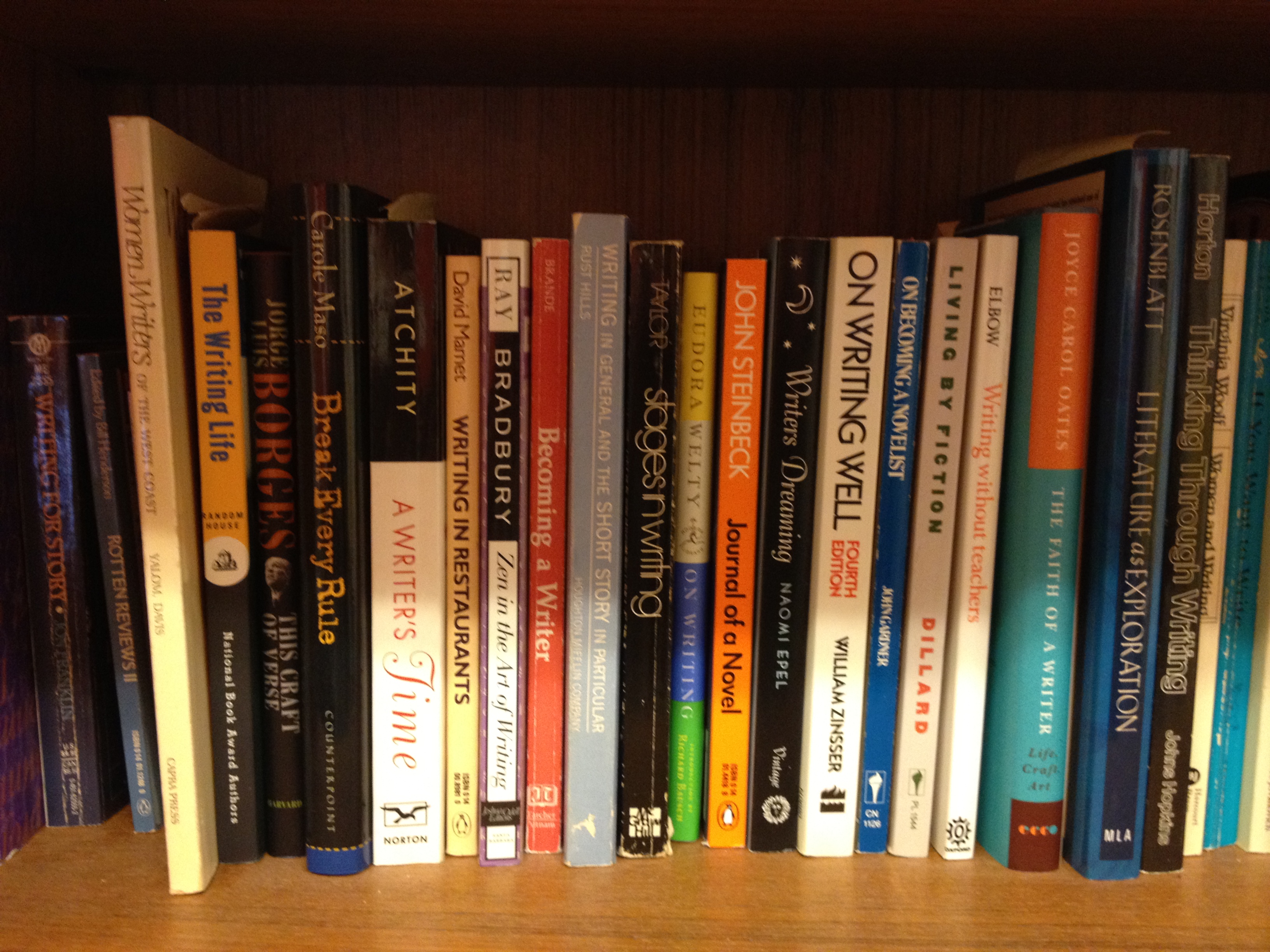

Continue reading
Filed under Howling at the moon
Hi Dogpatchers! Song of the Siren just posted an interesting interview with poet, Michael Odom, author of the chapbook “Strutting, Attracting, Snapping.”
Quotes from the interview: “In art, the great goal is the beautiful, not the pretty: the beautiful is attractive in the sense that your 75-year-old spouse dying of colon cancer is attractive.”
“I think the half-worked conundrum of Feminism/ objectification/stalking mixed with Romeo waiting in the bushes outside Juliet’s window is the most existentially traumatic modern transition the West is trying and failing to make.”

Read the full interview here:
Filed under Howling at the moon






Read more from Jilanne at The Writer's Shadow (JilanneHoffmann.com)

Read more from Laurel Leigh at DearWriters.com













young adult, middle grade, children's books
A topnotch WordPress.com site
The greatest WordPress.com site in all the land!
AS I TOLD THE GIRL THAT I LOST MY VIRGINITY TO, THANKS FOR LAUGHING AT ME HERE TODAY.
Eternal Beauty of Nature
The greatest WordPress.com site in all the land!
Perfection is next to insanity.
A great WordPress.com site
Berbagi Pengalaman Dan Catatan
The site for a new perspective on books and films
be the first to hear it
Writer, dog mom, living with low-grade serous ovarian cancer
comics, pop culture and related topics
Imagination becomes art when passion tricks insecurity
My art is the child of my imagination!
A topnotch WordPress.com site
Brian Marggraf, Author of Dream Brother: A Novel, Independent publishing advocate, New York City dweller
Mundus vult decipi
Writing stuff
4 out of 5 dentists recommend this WordPress.com site
Fibromyalgia | Writing | Health | Travel | Self-Discovery
#DIPLOMAT #AFRICA #WORLD
How to smile at the void - and other fun stories
MANNERS MAKETH MAN, LOST BOYS FAN & PERPETAUL CREATIVITY.
Random Observations of life
The immeasurable terrors of her mind...
Life in progress
Poetry, Art & Photography
more than a bracelet collection
Er is geen weg meer terug!
Blogging on sketching art journals, creating, painting!
Enter a world of interplanetary space travel, magic, varied cultures, and a long standing prophecy that will soon be fulfilled.
Reviews of Children's Board Books, Picture Books, Activity Books, and Graphic Novels
Reading, writing, dreaming
A cruel, futuristic vision created by science fiction authors James Courtney and Kaisy Wilkerson-Mills. ©2013-2016. All Rights Reserved. All writings available through Amazon.
The official page of the artist created to host the project 'CUT OFF'.
Books, writing, editing, etc.
A Magnificent Fountain of Gurgling Wit, Wisdom, and Intriguing Insights. Some Other Stuff, Too.
historical fiction, prose poems, flash fiction, yoga & writing workshops, writing & yoga workshops, freelance, blogging
 Dogpatch Writers Collective