Litquake Alert!

Got libations? Survival gear, including ibuprofen and rehydration tablets?

Ready. Set. Let it shake!!!!!

900 authors from all over the San Francisco Bay Area, the U.S., and the world.

Friday marks the 15th anniversary of Litquake, the best literary festival on the Left Coast. Sell-out shows include “The Best of Craigslist,” where writers give dramatic readings of found literature culled from REAL posts on Craigslist.  I’ve got tickets.

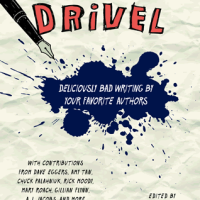
I’ll also be at “Drivel,” where some rather famous writers read some of their less-than-stellar prose.

Screen Shot 2014-10-08 at 10.45.49 PM

Who could resist?

Interested in poetry? Try “A Flight of Poets” or maybe “Dark and Stormy: Contemporary Swedish Poetry.”

Adventure travel? “Into the Wilderness” or “Bicycle book tours,” depending on what your idea of adventure and travel really is.

Sci-fi? Try “Into Tomorrow.”

31060547_s


Something from the heart? Try “Tales of Love and Longing,”  “Hot Flash Fiction,” or “Family Secrets.”

Something edgy? Try “Walk on the Wild Side.”

Need to feed you inner chef? Try “Sausages and Syrah.”

13995016_s

The opening night party on Friday, October 10, will be celebrated quinceañera-style. Think pink taffeta and a shot or two of tequila. Oh, and don’t forget your tiara.

On the last night, October 18, the world’s largest Lit Crawl commences, 101 events in three hours. 

See you there!

FULL FESTIVAL GUIDE PDF

MAP AND GUIDE FOR LITCRAWL 


3 Comments

Filed under Howling at the moon

Neglect of a Different Sort

Some years ago Philip Roth despaired at the dwindling number of what he called ‘real’ readers left in the United States, readers committed to reading serious books written by serious writers.

Back in the Day

Back in the Day

By some arcane system of his own devising Roth came up with an exact figure, one which I forget, but by his calculations there were only somewhere around five thousand of these ‘real’ readers left in the country.

Roth was reaching a point in his career where he was finding it harder and harder to see the point in writing books anymore. He also was mourning the loss, I think, in the importance of books and literature in American cultural life. But then Philip Roth has gone through several periods throughout his long and storied career (the awards he has received by themselves take up one full page on his bio sheet) when he was in despair over the nature of the book business.

Who could blame him?

Depending on who’s doing the telling, serious literature has been in serious decline for pretty much ever, a victim of benign neglect or communal and/or commercial indifference. And as many now know, Roth finally gave up writing altogether a couple years ago, and recently gave up (or so he says) reading, too.

Philip Roth threw this ‘five thousand readers’ number around for some time until a friend pointed out to him that while five thousand might not seem like a lot, if he was to line up all those people and have them pass one at a time through his living room, while he shook each of them by the hand, that by the time he got to the end of that line, Roth — any writer, for that matter — likely would be reduced to tears.

Neglect, I guess, is in the eye of the beholder. Continue reading

5 Comments

Filed under Rants

Overcommitment

Just returned from the annual August tour de famille on the East Coast and in the Midwest. Well, that’s not really true. We’ve been back since August 26. Really late in the evening on August 25, but our keys were with my husband, and he wasn’t with us. So we arrived at baggage claim at SFO only to realize that it was midnight, and we didn’t have keys to our humble abode.

This event symbolized our August. But now that we’re back, what is my excuse for being late to the post?

Overcommitment. You know you’re overcommitted when you can’t recall what you’re supposed to do next because there are too many things competing for “next.” And overcommitment stalls my forward movement.

I’m working on picture book fiction and nonfiction and literary short stories in addition to giving my novel-in-training some gas. I’ve got two kidlit writing groups in addition to the dogs at the patch. I’m taking a nonfiction picture book writing class where I’m supposed to have a first draft to critique in two weeks. But I just discovered last night that my topic is too complex (or at least the way I’ve envisioned it right now) to move forward, so I spent the evening last night looking for a new subject.  When I originally signed up for the class, I was going to do a biography, but it turned out that the living person I want to write a biography about is wary of saying “yes.” Sooooo, how many times can I go back to the drawing board?

10256189_s

And it’s a new school year with many library liaison activities, including planning for an author visit, creating a new library “wish list,” and getting new library volunteers up to speed on working with classes.

And new afterschool activities every night of the week. And….I’m supposed to be volunteering for Litquake and visiting my new writing group that meets North of SF.

And then there was the unexpected death of my mother-in-law the night of my father-in-law’s memorial in mid-August that continues to haunt me. I’m not sure if haunt is the right word, unless an intermittent replay of the middle-of-the night knock on the window and subsequent events qualifies. It does explain why my husband wasn’t with us when we returned without keys. He (the guy with the keys) took a side trip to his parents’ home to get things in order.

But I’m a writer, right? And I’m supposed to be getting something done. But at the moment, I’m not doing anything well. Getting anything finished, polished. I run from one thing to the next, often without making a single edit. Just enough time to get started before I’ve got to move on to something else.

The center cannot hold. And I wonder if there are writers out there who work best like this? If there are, I wish I were one of them. But I am not, and I have to make some changes. I hope everyone else out there is being more productive than I am right now.

13 Comments

Filed under Rants

Living in the Great State of Lynch

There’s a conversation that’s been heard a lot over the years in these parts—that being upper Western Washington, near the Canadian border:

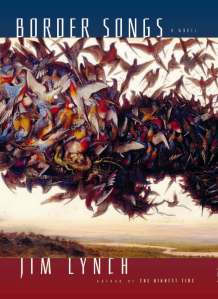
“Did you like Border Songs or The Highest Tide best?”

Note that there are built-in assumptions hard-wired into the DNA of any denizen of this rainy realm:

  • The listener has read both books by Jim Lynch.
  • The listener absolutely has an opinion.
  • If the listener agrees with the asker, both will nod smugly at their mutual rightness.
  • If the listener disagrees with the asker, it will be even more fun to argue the merits of each story, just like Norm and the professor hollering at each other across the ditch.

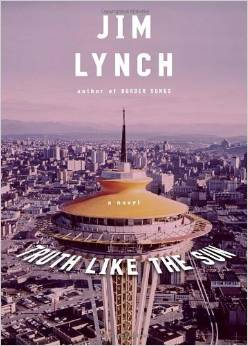
Truth Like the SunSince the publication of Jim’s third novel—yep, we call him “Jim,” because we feel like he is our author, in the sense that we live spittin’ distance from Border Songs’ setting on the Washington-Canadian border—the conversation widened to “Did you read/like/love Truth Like the Sun yet?” (There’s an awesome interview of Jim atop the Space Needle in Seattle.)

Again, some built-in assumptions:

  • The listener, like everyone around here, preordered book three and started reading it standing at the mailbox.
  • That Miles, Brandon, and Roger should probably have monuments built in the center of town (or the center of each town; arguably Roger does).
  • That having to choose a favorite among the books might be like admitting to loving one son/daughter more than his/her brothers/sisters—completely inappropriate yet sometimes done in secret.

Occasionally, some unfortunate soul admits in the barest of whispers to not having read one of the trio, or, god simply forbid, any of them. Far less often, someone blurts out awkwardly that they haven’t actually heard of Western Washington’s equivalent of a duke, at which point we refrain from scolding them outright because our mother taught us to be polite, but someone won’t be able to resist saying something like, “Were you kept underneath the stairs until recently, like those people in that creepy Wes Craven movie?”

Setting foot inside these borders—above or below the “ditch”—and remaining uneducated about the life and times of Brandon Vanderkool or Mr. Seattle is akin to living in San Francisco and never having been to MoMo’s. Some things just can’t and shouldn’t be forgiven. Picking up on the below stairs theme, and to help break any awkward silence, someone will then say that Jim Lynch has been known to write in his basement, at which everyone will nod knowingly, regardless of whether they knew that or believed it, but it just seems right. That will lead to fragments of knowledge and/or myth people presume to know:

  • His agent sold The Highest Tide when it was only half-written.
  • He wrote two other novels that he never bothered to publish; how cool would it be to read those, we say, reverently.
  • His next book (Before the Wind) involves sailing.
  • Oh yeah, he sails a lot, we say, as if we know exactly how much a lot is, but we know it’s enough that it’s gonna turn out to be another killer story.
  • (Read more about Jim on his website.)

Border Songs birdsAt any point, someone will inevitably yell, “Nineteen!” sending us all into peals of laughter, and god help the poor soul who doesn’t know and earns more pitying glances. There are inevitably a few showoffs in the party, who try to impress everyone by comparing Tom Robbins and Jim Lynch stylistically—well, we could compare snowflakes, too. It’s at least fair to say that both gentlemen dwell in the Pacific Northwest and have their own cult followings. Nonetheless, the comparisons often make for an extremely fun detour that can deteriorate to a lot of creative thumb waving and comparing to see who has the longest thumb—and there are also some overachievers who can name or have been to every locale used in the stories, sort of like this one woman I used to work with at the mental health center in Spokane who was an encyclopedia of Days of Our Lives and who could fill us all in on the lineage of relationships and feuds for the past decades of the show. This would occur during lunch in the quiet room, where we brought our lunch to eat and watched Days of Our Lives, and you guys don’t even begin to start laughing, because there were plenty of guys in that room who cared deeply about Bo and Hope.

“Speaking of which, do you think you know who and you know who will make it?” someone might ask.

The after story of Lynch’s characters is something we care about deeply. In a place where educated folks drop their g’s because they do, and socks and sandals make a weird kind of sense in the climate (having moved here from the SF Bay Area, I confidently double-dog dare you to resist more than three seasons), the zany ensemble of Lynch’s gives voice to the sort of experiences and issues that characterize us near-the-border dwellers and our frenemies to the north. Continue reading

4 Comments

Filed under What I'm Reading Right Now

Literary Fiction – Are You Still Awake?

Just returned from my writing retreat at the Community of Writers at Squaw Valley.

The first panel (How Plot Works) discussed why literary fiction bores readers. Who wants to spend all that time in a character’s head if nothing’s going to happen? Say what?! Maybe they have a point.

6992297_s

So the panel chatted about how to keep readers turning the pages:

  • Christina Meldrum, a former lawyer, creates tension through structure. She builds the first half of a story bell curve where the clues get more important to the story the closer she gets to the top. Something life-changing then happens at the apex.
  • Christian Kiefer does not outline or have any idea about what’s going to happen in his stories. But a writer can’t expect the reader to care more about the MC’s life than the MC does, so he does make sure his characters are on fire for something. It’s even better if there are multiple fires to complicate the story.
  • Janet Fitch said “you’ve gotta tie the girl to the tracks.” Don’t play the reader out so much that they lose interest. In scene, show character traits and then put pressure on those traits. The MC must let go of one or more traits while acquiring others to make a necessary life change.
  • Michael Jaime-Becerra uses positive tension (information that is doled out to the reader logically) instead of negative tension (information that is withheld from the reader unfairly). “The Swimmer” by John Cheever is an example of brilliantly withheld information.
  • Fitch added that suspense is fair, surprise is a trick. Build suspense.
  • Meldrum observed that the power of perspective allows the writer to give limited information. Humans are fallible, so the narrator can’t know everything, especially about themselves.

They finished by discussing magic: how endings must be both inevitable and surprising. Sadly, writers can’t force that Eureka!” So keep your butt in the chair, keep plottin’ away, and run with it when inspiration strikes. Oh, and don’t let your readers fall asleep.

10750239_s


Christina Meldrum is the author of Amaryllis in Blueberry and Madapple.

Christian Kiefer is the author of The Infinite Tides.

Janet Fitch is the author of Paint It Black and White Oleander.

Michael Jaime-Becerra is the author of This Time Tomorrow and Every Night is Ladies’ Night.

3 Comments

Filed under Craft

Guilty until Proven Innocent

anthony inmate pic

Anthony’s mugshot from 2006

My essay titled WE SHOULD DO SOMETHING was just published in the July 2014 issue of The Sun.

It’s about my nephew, Anthony Shaw, who was arrested and charged with the murder of his girlfriend’s two-year-old son.

This is a story about guilt and innocence and trying to live with the difference.

Some readers have asked me if this is a true story.

It is.

Read an excerpt or subscribe to The Sun.


The Sun July 2014 Issue 463

The Sun
July 2014
Issue 463


4 Comments

Filed under Publication

They Probably Have a Very Long Word for It in German

Scientists in Germany recently have discovered that creative writing involves using various parts of our brains, your correspondents at the Dogpatch are not the first to report.

images-1

Researchers at the University of Greifswald in Germany strapped willing participants into MRI scanners to track their brain activity while writing creatively. And this new research into the neuroscience of creative writing discovered that a broad network of regions in the brain all worked together when people are turning out a piece of fiction, which may not be news to discerning readers of the Dogpatch.

But what may come as news is that the inner workings of professionally trained writers showed some similarities to people who are skilled at other complex actions like music or sports.


Magnetic Fields 

The researchers at the University of Greifswald could not let their subjects use a laptop to write with because the magnetic field generated by an MRI scanner would have hurled it across the room. So subjects had to lie flat on their backs, while their writing arm rested on a desk nearby, as they scribbled on a piece of paper clipped to a board set at an incline beside them. A system of mirrors let them see what they were writing while their heads remained cocooned inside the scanner.

Some of you may be asking how creatively a person can be expected to write while lying flat on her back, her head strapped into an enormous, humming metal tube, but what perhaps cannot be in question is the elaborate nature of the protocols employed by the scientists at the University of Greifswald.

Before having their subjects attempt creative fiction, the researchers first had them simply copy out some text, giving them a baseline reading of the subjects’ brain activity during writing.

They then had their volunteers simply think about what they were planning to write. During these ‘brainstorming’ sessions, some vision-processing regions of the brain became active, suggesting that the subjects were, in effect, seeing the scenes they intended to write.

Finally they had their subjects write creative fiction, and here the researchers found that other regions of the brain were called into play, including the hippocampus, that part of the brain which retrieves factual information.

There was also activity noted in a region near the front of the brain that is crucial to holding several pieces of information in mind at once, suggesting that juggling several characters and plot lines may put special demands on it.

images-3

But the researchers at University of Greifswald recognized a big limit to their study: none of the participants had prior experience writing fiction.

Would the brains of full-time writers respond differently? Continue reading

4 Comments

Filed under Craft

“Charity’s Discovery” – a Biscuit story by David Marx

10190444_s

Hello from the Dogpatch. In the style of Sherwood Anderson’s Winesburg, Ohio, comes Biscuit, a collection in process by Dogpatch Founder David Marx. For this “dogfight” round, we read and commented on “Charity’s Discovery,” a story from the collection in which the lead character crosses from girlhood to womanhood and hopefulness to bitterness. Below is a bit of the story along with our remarks to David. Feel free to chime in!

~~~

We’re also very pleased to announce that another of David’s Biscuit stories, “Merle, Molly and the Cast-Iron Frying Pan” is forthcoming in The Saint Ann’s Review.

~~~

—From “Charity’s Discovery”:

She had gone to the restroom and while she was away, Ed Billick put a tack on her chair. When Charity sat on the tack, she let out a little scream. Ed’s desk was next to Charity’s making his guilt obvious. Now the teacher, Gladys Horton, was preparing to punish him. Miss Horton walked slowly to Ed’s desk and as she did, Charity saw the look on her face; it belonged on the face of an executioner about to administer justice and eager to do the task.

“Honestly, it didn’t hurt at all,” Charity said, hoping to prevent Miss Horton from taking drastic action.

The teacher stared back at Charity and said, “If we don’t punish them when they’re young, they will surely grow up to be criminals.”


Jilanne: The Writer's Shadow

Jilanne: The Writer’s Shadow

Jilanne’s comments:

It’s been awhile since I’ve had the pleasure of reading one of David’s stories in this collection.

Here we are in a small town called Biscuit where Charity, a young woman virtually chained to her mother (Faith), ends up a thwarted spinster. In this story, David is doing something immensely difficult, distilling 40+ years of this woman’s life into a single chapter. And for the most part, David’s effort is successful. His black humor marks every page even while we’re watching the train wreck that is this woman’s life. But as with all good stories, Charity is just as much a victim of her own reluctance to fight her mother and change the status quo as she is a victim of her mother’s cruelty. Bravo!

Here’s what I think needs work: Right now, there are a few places where I think the telling vs. showing are flipped. A couple of key scenes need to be fleshed out instead of racing by with exposition. And similarly, when you’ve got a great scene, don’t prep us with how this is going to change her life, include the scene that changed her life, and then tell us that it did indeed change her life. It’s a great scene. Trust us to get it.

I want to see the conflict build between Charity and her mother so that when we get to the end, it’s earned. Right now, we don’t get to see how Faith squelches every romantic interest Charity has ever had until after the “big one.” I need to see these thwarted attempts beforehand and watch Charity turn into a pressure cooker. Continue reading

2 Comments

Filed under Dogfight

Coen-Esque, You Betcha!

“A little less Fargo and a little more Raising Arizona,” an editor wrote to me once about a story in which I’d killed off one of the characters.

The old church I used as a model for the "old Lutheran Church" in the story "Dearest" was torn down long ago. This is the Catholic Church in Bruneau I grew up attending, although I also went to Sunday School at the Protestant Church up the street, since they had way better music and cookies.

The old church I used as a model for the “old Lutheran Church” in the story “Dearest” was torn down long ago. This is the Catholic Church in Bruneau, Idaho, I grew up attending, although I also went to Sunday School at the Protestant Church up the street, since they had way better music and cookies. It was fun to conceive this story in Bruneau and then pick it up and move it to Moorhead, Minnesota. I moved it back and forth a couple times and finally decided that Moorhead in Clay County worked the best for the story purpose.

First the editor buttered me up by saying that my story reminded him a bit of the Coen Brothers.

I was ready to put on hot pink lipstick just at the thought of my work reminding anyone of those guys, whose work I highly admire.

The film analogy was an especially apt one in this case, where I’d veered the story in too dark a direction for its overall tone. That comment stuck with me and has been a reminder of my tendency to write dark endings, whether or not they’re the right one for the story. The dead character was brought back to life in the aforementioned story, and the story was better for it.

But I keep having to learn the lesson over and over again with each new story. Recently, the Dogpatch reviewed a story of mine, which is due out this month in Clover: A Literary Rag, the gorgeous letterpress magazine published by the Independent Writers’ Studio.

In the small town in which I grew up, there was a guy we kids were afraid of for no justifiable reason I’ve ever known. My friend Cynda and I would ride our bikes really fast past his house on the way to school. That became the seed of the story “Dearest,” which started as my way to understand why we kids needed a monster to be afraid of, and why it was also fun to be afraid.

The Bruneau Canal in Idaho, where I originally imagined the character in the story would walk. I swapped it for the Red River that separates North Dakota and Minnesota, as a more believable place for the character to lose her money in the wind.

The Bruneau Canal in Idaho, where I originally imagined the character in the story “Dearest” would walk singing a tune about two cowboys who meet the devil. I swapped it for the Red River that separates North Dakota and Minnesota, as a more believable place for the character to lose something she couldn’t retrieve by jumping into the water. It was hard to lose the Bruneau Canal, since I grew up playing alongside it and swimming in it, but the expanse of water needed to be wider and faster moving for the scene to work.

Continue reading

8 Comments

Filed under Notes from the coffee shop

Write on Mamas – New Anthology

Hello Dogpatchers! I just read this blog post by an editor/writer from a group called Write on Mamas. They are professional writers (and those just beginning their writing journey) in the San Francisco Bay Area and beyond. I think the post contains some valuable insights about “beautiful writing” and what the editor learned while shepherding the group’s first anthology into publication.

So often, a piece can be beautifully written  (crafted) but feel lacking. A loooooo-n-g time ago, I took a poetry workshop and spent a great portion of the time discussing whether certain poems had “duende.” Here’s Wikipedia’s definition of the word:

Duende or tener duende (“having duende”) loosely means having soul, a heightened state of emotion, expression and authenticity, often connected with flamenco[1] The artistic and especially musical term was derived from the duende, a fairy or goblin-like creature in Spanish mythology.

I think this is sometimes the missing element in what would otherwise be called “beautiful writing.” So here’s hoping you are all out there inviting that little fairy goblin into your work.

Link to the blog post:

http://writeonmamas.com/tips-on-editing/

Write on Mamas’ new anthology:

Screen Shot 2014-05-30 at 11.08.47 AM


9 Comments

Filed under Craft