Category Archives: Rants

For Real?

Someone I know lost a very close friend this past weekend. He was only 43 years old and left behind a wife (the love of his life) and two kids, one a 4-yr-old diagnosed a few weeks ago with a rare form of cancer. The child had come home last week from his first round of chemo and a follow-up stay at the hospital, and over the weekend, the father had a massive heart attack in his sleep. In the real world, this is tragic. Extraordinarily tragic.

In the world of fiction, would a reader believe this story?

Ever had someone read your work and say “I don’t believe it happened that way”? I have. And that means I didn’t do a solid job of constructing the fictional dream that draws the “buy in” from readers. I put on the hard hat and built the house with some old rotten planks I found lying around, ones that had seen better days, but it’s a house, right? For some people, the structure may hold, but many will find the whole thing too shaky to be willing to walk through the door.
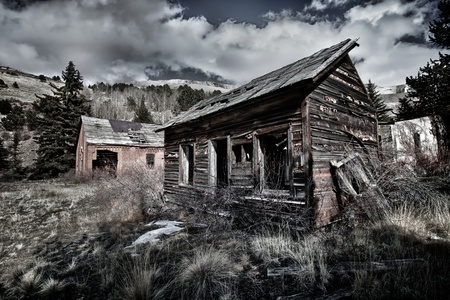
10294921_s

I wouldn’t go in there

And it doesn’t matter that it really happened if you can’t make the reader believe it, right?

I just came back from a writing conference where John Gardner, the author of “The Art of Fiction,” got slammed once again. But it’s funny how everyone objects to the “voice” in that book—he’s soooo snotty!!—but few ever refute his points. On page 22, where he explains how to get buy-in, he categorizes three types of writing:

1) The realistic writer makes events convincing through verisimilitude, real world, real details, real responses. This is Alice Munro’s bailiwick.

2) The tale teller writing of ghosts, shape-shifters, or characters who may never sleep depends on confidence and authority, the “quality of voice” to charm the reader or distract the “critical intelligence,” what Coleridge called “the willing suspension of disbelief.” I’m thinking right now of a recent read called The Demonologist by Andrew Pyper. The narrator’s voice begins powerfully and stays strong throughout the story, and he’s also a master of the “telling detail.”

3) The yarn writer, the one whose lies are so outrageous and entertaining that the reader is pulled along by the brilliance of the falsehood. This one is easy. Think Mark Twain.

Gardner goes on to explain that all three types of writing depend on precise detail. Hmmmm, what details? Well, if your character walks into a bar, your reader knows what a bar looks like:

9142047_s

NOOOOO!!!!!! Not that kind of bar! This kind…

13889259_s

Get the point? Fill in the pieces that MUST be known and let the reader fill in the rest of the fictional dream.

If the reader is moved to ask the dreaded question: “Would ____ really have said/done that?” we know the reader has fallen out of the dream and on to the floor.

8788075_s

Ouch!

And readers don’t like such a rude awakening.

Pay attention to what is real, the emotional core of the moment. Write from that center of authority and—yes, I’ll use that overused word—authenticity. So that is craft, right?

Now comes the “other” part of writing.

One of Gardner’s points that often gets glossed over in this “detail” business is that fiction is not meant solely to entertain or distract us from our personal concerns, but “helps us know what we believe, reinforces those qualities that are noblest in us, leads us to feel uneasy about our faults and limitations.”

To do so, we must move beyond craft. Gardner says:

“No amount of intellectual study can determine for the writer what details he (she) should include.” Everything must be chosen “by feeling and intuition. And one of the things he (she) will discover, inevitably, is that the images of death and loss that come to him (her) are not necessarily those we might expect.”

He goes on to suggest that in order to tell the truth, one must empty one’s mind of those images that instantly come to the forefront. Or as Karen Joy Fowler suggests: “I find that if I go with my first ‘gut response,’ it is the easiest, most facile, most seen before image. I have to work harder to figure out what should really happen.”

17472648_s

Keep throwing the darts until you hit the bulls-eye

In The Year of Magical Thinking, Joan Didion describes how her husband died, chatting with her and drinking a cocktail while she prepared dinner.

“I only remember looking up. His left hand was raised and he was slumped motionless. At first I thought he was making a failed joke, an attempt to make the difficulty of the day seem manageable.

I remember saying Don’t do that

When he did not respond my first thought was that he had started to eat and choked…In the kitchen by the telephone I had taped a card with the New York-Presbyterian ambulance numbers. I had not taped the numbers by the telephone because I anticipated a moment like this. I had taped the numbers by the telephone in case someone in the building needed an ambulance.

Someone else.”

The details she selects to describe the event and her specific response—she had difficulty eating for months afterward because the trauma occurred at mealtime—leave the reader with no room for disbelief.

But one more thing: She sets the scene with thoughts that everyone has:

“Confronted with sudden disaster, we all focus on how unremarkable the circumstances were in which the unthinkable occurred, the clear blue sky from which the plane fell, the routine errand that ended on the shoulder with the car in flames…”

Again, we are right there with her. We know this happens.

But how do you find that magical intuition that knows what details are necessary for the story? Spin a sticky web, and go to sleep. See what you’ve caught in the morning?

8272450_s

If that doesn’t work, try practice. Just like meditation, you’ve got to show up and do the work of emptying your mind before you fill it up. Think “Zen mind, beginner’s mind.”

So when a young father with a child who’s just been diagnosed with a rare form of cancer shows up in your fictional world, find the details that only you can provide, the ones that “make it real” for you.

4 Comments

Filed under Rants

You deserve so much better

Savannah Brown

Savannah Brown

Hello from the Dogpatch! Check out this amazing slam poem by seventeen-year-old Savannah Brown featured on Erika Fuego‘s site, where you will find a delightful, eclectic mix of writing and imagery.

“You Deserve So Much Better” is one of those performance art pieces that makes you grateful there are poets in the world. You can see more of Savannah’s performance art videos at: http://www.youtube.com/user/savanamazing?feature=watch

Thanks to Erika for featuring this video. And go, Savannah!

You deserve so much better.

Leave a comment

Filed under Rants

A Tale of Infidelity

For all you folks out there who don’t yet know about Mike Allegra’s blog HeyLookAWriterFellow, here’s a post you shouldn’t miss:

Literary Lothario

1 Comment

Filed under Rants

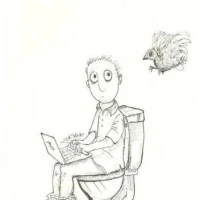
Writing Between the Toilet and the Window

My ToiletHello from the Dogpatch!

One time a college I was teaching for sent a photographer to my house wanting to take a publicity shot of me in my “creative space.”

The guy showed up to see where I work—I tidied up my little basement desk and even stuck a dried flower in a vase. He settled for a pic of me sitting in a rocking chair in my living room with a stack of galleys on my lap writing fake notes with a pencil.

“If you smile a little less, your eyes won’t be so crinkly,” he said.

I used to work a lot harder to decorate my writing space. During grad school, I hung giant sticky notes over my desk with important-looking chapter outlines for my culminating creative project. I’d use different-colored Sharpies to scrawl cryptic messages to myself, like “Juanita wouldn’t be afraid of the buffalo.”

Those big sticky notes really made me feel like a writer.

When I moved from the SF Bay area to Bellingham, I ended up with a little daylight basement to use as an office. The sticky notes of course came with, along with pics of cute Liv Tyler that I cut out of magazines and laminated, since Livvie is the closest visual approximation of the Juanita character in my mind.

One day a guy came to fix something broken and asked if the pictures of Liv/Juanita were pics of me.

I snorted. “For crying out loud,” I said. Or something like that. Continue reading

8 Comments

Filed under Rants

7 Parenting Lessons From Literature

Hello from the Dogpatch,

Here’s a parenting lesson from 101 Books to which we at the Dogpatch bow down. Major Woofs for this post!

Robert's avatar101 Books

Parenting is hard work. I know that’s a cliche, but it’s a well-earned cliche.

Kids are pretty awesome, and they can even teach you a thing or two about reading, but they also have their moments. That’s why, if you want to be a parent, it’s important to make sure you are not a mental whack job.

Mental whack jobs who are parents usually produce kids who eventually become mental whack jobs themselves. This is not good.

Since fiction is often just a mirror of reality, there’s a lot to learn from literary parents, both good and whack jobbish.

Quite a bit, actually. Let’s take at some parenting tips I put together based on lessons I’ve learned from literary parents.

View original post 663 more words

Leave a comment

Filed under Rants

Fat Prose

In his excellent book on the craft of writing (On Writing), Stephen King presents a diatribe against the unnecessary use of adverbs. He wasn’t as hard on adjectives and I think he should have been. Both are modifiers, which are words and phrases that weaken or even uglifiy what otherwise might be good writing, by adding layers of fat to what was elegant prose. This is certainly not new thinking, yet, lately the use of the word, “so” has grown exponentially as a modifier of the phrase, “Thank You.” It’s no longer adequate to express one’s gratitude to another for anything by simply saying, “thanks,” “thank you,” or even “thank you very much.” It’s come to be expected that a complete “thank you” includes the phrase, “so much,” as in “Thank you, so much.”

On the page the word, “so,” appears innocuous, particularly since it consists of but two letters, but recently it has invaded and cheapened the phrase, “Thank you.” I suspect that “so” initially entered the lexicon as a way to enhance “Thank you,” and/or to take the place of the word “very.”

Part of what bothers me is how much equals “so much?” Is it measured as a percentage of the original Thank you? That would be difficult to quantify, but perhaps not as much, because that original thanks refers to an action done by someone else that engendered the original thanks. Now the word, “so” has become overused to the point where it no longer enhances the original Thank you. And modifying our prose rarely strengthens the text; instead the writer feels the need for a crutch and the result is weakened writing.

Thank you for reading this.

2 Comments

Filed under Rants

What a Feelin’!

Happy 30th!

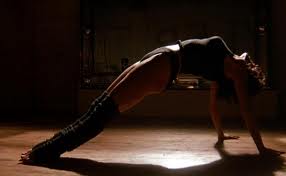
Beals BackbendIt’s been three decades since director Adrian Lyne brought us the film Flashdance. In case you missed it (or were just a playful glint in some hot postman’s eye when it premiered), you can relive the same story structure in Coyote Ugly from 2000, directed by David McNally and featuring a gutsy blonde wannabe singer instead of a gutsy dark-haired wannabe dancer.

In celebration of Flashdance, my favorite-ist film ever, until Jan de Bont gave the world Speed in 1994—here you may be excused if you are now bored out of your skull, but the film Speed beautifully illustrates three-act structure, and you can learn a lot by watching it 50 or 60 times. Plus, whichever way you swing, Keanu Reeves and Sandra Bullock are easy on the eyes—anyway, I put on my well-used Flashdance CD and started dancing around my bedroom in the shirt I’ve been wearing for 48 hours and my long underwear, doing my best Jennifer Beals imitation—or for any of you purists out there, my best Marine Jahan imitation. Continue reading

16 Comments

Filed under Rants

The Grapes of Mocking

I had to re-blog this from 101books.net. It is just too hilarious. Thank you, Robert!

Steinbeck Mocks the Publishing Process

Leave a comment

Filed under Rants

Potty Head

Hello from Bellingham WA on this windy evening. Which brings me to my topic—not the wind but the worry.

If worrying were an Olympic sport, I’d be caption of the U.S. team. If I listed everything I worry about, this blog would get far longer than Rapunzel’s hair, it would take up too much space, and WordPress might crash. That’s how much I worry. Enough to potentially crash WordPress and make me worry about the poor guy named Ted or something, who has to get up in the middle of the night and fix it. Sorry, Ted.

My itty bitty house is surrounded by 100-foot trees, and when the wind blows through the willows (okay, pine trees), I worry one or more trees will fall on my house. Or on my car. Or on me.

I have CSI-like evidence of the potential for this calamity. Continue reading

8 Comments

Filed under Howling at the moon, Rants

Hey there Dogpatchers, Laurel posted a little snippet from the seminar she taught at Chuckanut Writers Conference on her blog. Thought you all might be interested in taking a look at how screenwriting tools can be applied to other genres. Laurel rocks!

Laurel Leigh's avatarDear Writers

Dear Writers,
I was delighted to again serve on the faculty of the Chuckanut Writers Conference last week in Western Washington. Here’s a snippet from a session I taught on how writers can draw from film storyboarding concepts to create a text-driven version of a storyboard. In this moment, the discussion centered on the three-act structure paradigm.

Let’s turn to our friends the screenplay writers for a moment. It’s some of their tools that we are borrowing and modifying to make our stories. Looking at conventional film structure is useful in gaining a better understanding of story action and plot points.

The conventional three-act structure looks like this:

In Act I, is the setup. The character(s), the action of the story, the problem or question of the story is established.

View original post 629 more words

3 Comments

Filed under Rants